

Through the Joints or Through the Paver?
Permeable, pervious, porous. The words are often used as if they mean the same thing, but when it comes to paving they describe two very different ways of letting stormwater into the ground. Permeable pavers are solid units that drain through the joints between them. Pervious pavers or fully permeable pavers such as HydroSTON, are made from no-fines concrete, so water passes straight through the paver itself.
Both aim to reduce runoff and return water to the soil. The difference in how they do it affects performance, appearance, maintenance and long-term value.
We want to highlight the key areas where pervious and joint-draining permeable pavers differ, and why a fully pervious paver is the more complete solution.
1. How Water Enters the Pavement
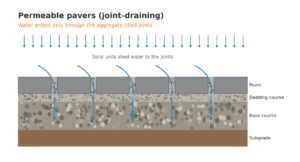
Joint-draining permeable pavers are made from dense, impervious concrete. Rain runs off the face of each unit into widened joints or openings filled with gravel, and only those joints carry water into the base below. The joints are a small fraction of the paved area.
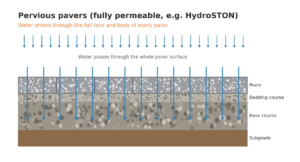
HydroSTON pavers are 100% permeable across the entire surface. Water passes through the face and body of every paver at 4.5 L/s/m2, so the whole pavement becomes the drainage surface. Rain is captured and filtered exactly where it falls.
2. Performance Over Time
All permeable pavements slowly collect fine sediment. In a joint-draining system, the joints are the only way in, so as the gravel fills with silt the whole pavement loses capacity. If the joints are not kept topped up, sediment can reach the bedding layer, where it can only be removed by lifting the pavers.
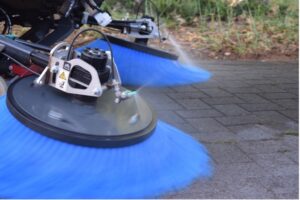
With HydroSTON, water continues to infiltrate across the entire paver face, even as sediment builds up. Fines are trapped in the top 0 to 10mm of the paver, never reaching the bedding or base. Infiltration is restored in place by sweeping or water jetting with vacuum extraction. The result is a structural life of more than 50 years and hydraulic performance sustained for more than 30 years.
3. Surface and Aesthetic Appeal
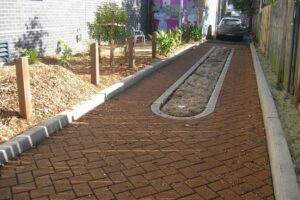
Permeable pavers need open, gravel-filled joints to work. The loose aggregate can wash out, be picked up by sweepers and leave an uneven finish, and the wide joints are less comfortable for heels, prams and wheelchairs.
HydroSTON pavers are laid butted together with no joint gaps, creating a smooth, uniform surface with a P5 slip resistance rating. Available in a broad range of colours and laying patterns, they suit plazas, footpaths, tree surrounds, driveways and car parks alike.
4. Maintenance
Maintaining a joint-draining permeable paver means sweeping and then replacing the jointing gravel to keep every joint full, a task that is easily overlooked.
HydroSTON needs periodic sweeping only. Where sediment has built up, water jetting with vacuum extraction restores performance. At the Royal Botanic Garden Sydney, HydroSTON installed beneath dense tree canopy in 2017 was restored toward its original infiltration with a single clean in 2025, without damaging the pavers or the base.
5. Durability and Flexibility
Both systems are segmental, so individual units can be lifted and relaid for repairs or access to services. HydroSTON adds the drainage performance of pervious concrete to that flexibility. HydroSTON 50 suits pedestrian areas, and HydroSTON 80 carries light and heavy vehicles in car parks and commercial driveways.
A Smarter, More Sustainable Choice
By choosing a fully pervious paver, landscape architects, engineers and developers gain a pavement where every square metre manages stormwater, not just the joints. HydroSTON combines this with a refined finish, simple maintenance and a proven track record across Australia since 2007, supporting cooler, greener and more water sensitive urban spaces.