A maintenance trial demonstrating the long-term performance of permeable pavers
In 2017, 265 m² of HydroSTON 80 Charcoal permeable concrete pavers were installed in a pedestrian forecourt outside the Plant Clinic at the Royal Botanic Garden Sydney. Located beneath mature trees and exposed to constant foot traffic, the area is subject to ongoing leaf litter and organic debris, making it a demanding environment for any permeable paving system.
After eight years in service, the pavers remained structurally sound, slip-resistant, and visually consistent. As expected in a high-debris setting, a gradual reduction in surface infiltration performance was observed over time. This reduction did not indicate system failure, it rather reflected the accumulation of fine organic material typical of landscaped environments. The area continued to function effectively, supported by routine surface cleaning using leaf blowers.
Maintenance Trial: Restoring Permeability
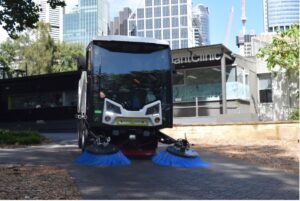
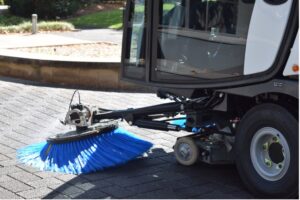
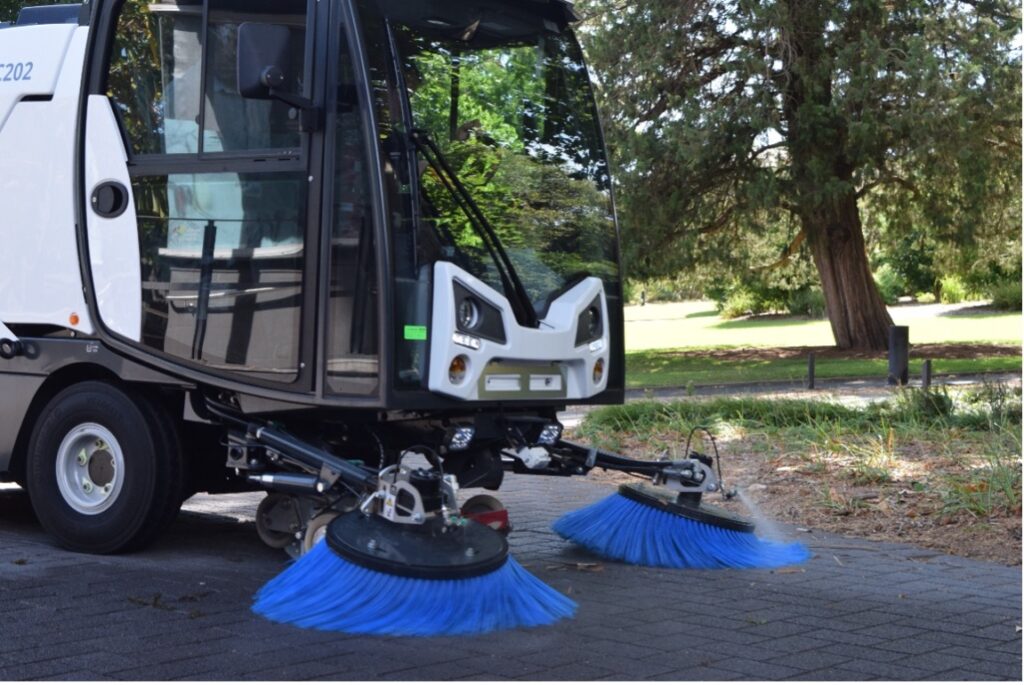
In November 2025, HydroCon worked with Bucher Municipal and the Royal Botanic Garden Sydney Asset Management team to undertake a targeted maintenance trial. The trial used Bucher’s latest evolution of the C202 sweeper suction vehicle to assess whether modern suction sweeping technology could restore permeability and surface condition after nearly a decade of minimal intervention.
The trial focused on:
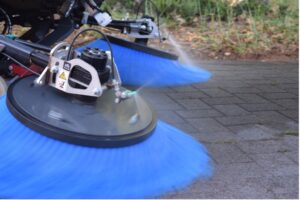
- Assessing the effectiveness of combined sweeping, suction and water jetting in removing fine sediment
- Evaluating operational parameters, including suction pressure and brush contact angle
- Establishing a reference point for future maintenance strategies in high organic-loading environments
To know more about Bucher Municipal compact sweeper vehicles, visit Compact sweepers models | Bucher Municipal
Outcomes
The maintenance trial resulted in a clear improvement in both surface condition and infiltration performance. Fine sediments embedded within the pavers’ pore structure were effectively removed without disturbing the paving layout, bedding layers or underlying structure.
Post-maintenance inspection confirmed that permeability and surface condition had improved consistently across the treated area, with no evidence of structural disturbance or damage to surrounding landscape elements.
Observed outcomes included:
- Restoration of infiltration performance towards original levels
- Improved surface cleanliness and appearance
- A fast, non-invasive cleaning process suitable for operational public spaces
- No damage to pavers, subgrade or adjacent landscape features
Implications for Public Realm Infrastructure
In environments with high organic loading, such as beneath mature tree canopies, a gradual reduction in surface infiltration should be anticipated over time. This condition provides a practical trigger for targeted restorative maintenance, rather than an indication of pavement failure or the need for replacement.
The trial demonstrated that HydroSTON can be effectively rejuvenated through a single maintenance intervention, without lifting, relaying or excavation. This supports its suitability for high-use public environments where access disruption and asset downtime must be minimised.
In operational terms, this delivers:
- Continued support for WSUD objectives through reduced surface runoff
- Improved soil moisture availability for adjacent tree root zones
- Reduced long-term maintenance effort and lifecycle risk for asset owners
Designed for Long-Term Performance
Unlike permeable pavement systems that rely on joint infill materials to convey water, HydroSTON is permeable through the full depth of each paver. This design enables deep-cleaning techniques, including suction and high-pressure water jet, to restore hydraulic performance without compromising pavement integrity. Systems dependent on joint materials may require joint replacement or reconstruction to achieve comparable outcomes.
Recommended maintenance practices include:
- Routine surface cleaning to remove leaf litter and organic debris
- Periodic vacuum suction to limit the accumulation of fine sediments
- Restorative deep cleaning at multi-year intervals, depending on site conditions
The outcomes of this trial are applicable to a wide range of porous pavements in urban parks, civic spaces and landscaped forecourts, particularly where permeable surfaces are exposed to high foot traffic and ongoing organic debris. For the Royal Botanic Garden Sydney, the 2025 maintenance trial reinforced the original design intent: a durable permeable pavement capable of delivering long-term environmental and operational performance.