
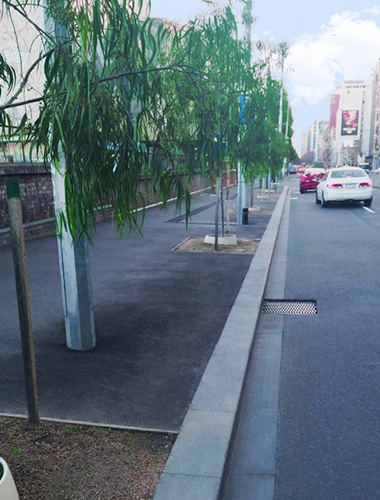
Passive Watering and Stormwater Treatment for Street Trees
Trees in sealed streets receive little of the rain that falls around them. Roads and footpaths shed runoff to the kerb and into the drainage network, while the soil beneath the tree stays dry. Councils water by truck through the dry months, and roots travel under footpaths and kerbs in search of moisture.
Solutions that water street trees with stormwater differ in what they do. Some deliver water to the soil only. Others also treat the stormwater, keep the soil open and reduce flows to the drainage network. In an Adelaide study, white cedar saplings receiving road runoff through kerb inlets grew 65% more in height over three years than saplings without them (Gleeson et al. 2022). They also differ in where captured sediment ends up and how it is removed.
This article compares how these solutions handle water, sediment and maintenance.
The Solutions Compared
Active watering. Water trucks, watering bags and watering points such as GreenBlue Urban RootRain deliver tap water to the root ball. Every visit is a labour cost.
Kerb cut-outs. An opening in the kerb lets road runoff flow onto a tree pit set below road level. When the pit fills, flows continue down the kerb to the next drainage pit (Mackay Regional Council).
Smart Soaker. A kerb pit with a grate, a maintainable/replaceable filter and a slotted sub-surface drain. It captures road runoff, holds litter and fine sediment in an accessible pit, and delivers filtered water by gravity to the root zone.
TREENET Inlet. A kerbside inlet developed in South Australia and supplied by Space Down Under. Runoff collects in a shallow bowl that is intended to work as a vortex to wash out debris and direct water into the inlet, which drains into a leaky well in the verge and soaks into the soil around the tree. In South Australia, an EPA-approved filter medium is available for the infiltration zone (Space Down Under).
SVC Monash Grated Inlet. A precast kerb inlet developed with the City of Monash in Victoria. Runoff enters through an 8mm aperture grate, debris and sediment are screened out in the unit, and an outlet pipe carries the water to structural soil or a soil vault (SVC).
Citygreen Strataflow Kerb Inlet and Stratavault soil cells. The Strataflow Kerb Inlet takes runoff through a front grate and pipes it to tree pits, at up to 18 L/s. Stratavault soil cells provide uncompacted soil volume under pavements and store water, but need an inlet to receive stormwater (Citygreen).
EnviroKerb. A precast permeable concrete kerb and channel from PPC Australia. Water passes through the kerb along its length, and the EnviroKerb Tray Inlet retains coarse and fine surface material in a tray at the kerb line. Units can be exchanged if the permeable matrix blocks (EnviroKerb).
Smart Soaker Explained
1. Treatment Before the Root Zone
Road runoff carries litter, leaves and fine sediment. Fine sediment that passes a grate or vortex bowl travels on with the water, and design guidelines warn that sediment entering a passive irrigation system can clog the tree pit and fill the water storage zone (CRC for Water Sensitive Cities).
Smart Soaker holds both litter and fine sediment in the pit before the water reaches the root zone. The grate keeps out litter and coarse material. The filter captures fine sediment while passing water at 1.5mm/s, so only filtered water enters the slotted sub-surface drain to the root zone. Light weight and heavy duty versions suit footpaths, cycleways and roads.
2. Maintenance
Lower cost inlets are cheaper to buy and install. Every inlet that takes road runoff collects sediment and needs cleaning, and blockage is a documented issue: the City of Monash reviewed passive watering products before designing its own inlet and found the biggest problem was maintenance, because the inlets clog (IPWEA).
Smart Soaker holds sediment and litter in an accessible pit, emptied by vacuum truck or by hand, typically once a year depending on the catchment. The replaceable filters are cleaned in situ or at the depot every 1 to 3 years. A missed clean causes more runoff to bypass to the drainage network, while the filter continues to keep sediment out of the sub-surface drain. Captured material is removed from the pit itself, so the soil around the tree is not disturbed.
3. Pollutant Capture, Infiltration and Pavement Protection
Smart Soaker is water sensitive urban design for trees. Each pit captures gross pollutants such as plastics and cigarette butts before they reach creeks and the sea, and captures total suspended solids before they reach the soil. Water delivered to the root zone does not enter the pit and pipe network, and infiltration replenishes groundwater and supports baseflows in creeks.
Roots grow toward water, so delivering water below the surface draws roots down rather than under footpaths, where they lift paving and create trip hazards. Healthier trees cool the street and add amenity. Smart Soaker also provides the filtered inlet that soil cells and structural soil need to receive stormwater.
4. Suitability for Western Australia
Smart Soaker is well suited to Western Australian conditions. Perth councils reported street tree losses after a recent dry summer, and the City of Joondalup noted that regular watering of all established trees is not possible with the water and labour available (Community News). Much of Perth sits on the sandy soils of the Swan Coastal Plain, where groundwater remains a key water source (CRC for Water Sensitive Cities). Frankston Council VIC has installed 11 Smart Soakers near the aquatic centre in sandy soils. The trees are quite healthy and there is almost no runoff to the stormwater system. Smart Soaker delivers filtered runoff into these soils, supporting the tree and replenishing groundwater.
Design Features at a Glance
| Solution | How water enters | Treatment before the soil | Where captured material is held |
| Active watering | Tap water by truck or watering point | Not applicable | Not applicable |
| Kerb cut-out | Opening in the kerb | None unless added | Tree pit surface |
| TREENET Inlet | Kerbside vortex bowl | Debris diverted by the bowl; filter medium available in SA | Inlet and infiltration zone |
| SVC Monash Grated Inlet | 8mm grate in the kerb | Debris and sediment screened in the unit | Precast unit |
| Citygreen Strataflow Kerb Inlet | Front grate in the kerb | Grate excludes debris | At the grate |
| EnviroKerb | Through the permeable kerb | Kerb and tray retain material | Kerb tray; units exchangeable |
| Smart Soaker | Grate in a kerb pit | Grate, pit and replaceable filter (1.5mm/s) | Accessible pit and removable filters |
Information about other products in this article is taken from the websites of each manufacturer and other publicly available material, current at October 2026. Product details may change; please confirm specifications with each supplier.
Summary
Smart Soaker waters street trees and treats the stormwater that reaches them in one kerb pit. All components are made in Australia, and Smart Soaker is installed in Mt Evelyn VIC, Newcastle NSW, Frankston VIC and the City of Brimbank VIC. Specifications, design guidelines, installation and maintenance information are on the Smart Soaker page.
About HydroCon
HydroCon Australasia is a specialist supplier of Water Sensitive Urban Design (WSUD) products for stormwater management, established in 2001. We supply three product families to projects in NSW, VIC, ACT, QLD and WA, and in New Zealand and the Asia Pacific region: HydroSTON® permeable concrete pavers, HydroCon® permeable concrete pipes and Smart Soaker. HydroCon is the exclusive Australian distributor of Smart Soaker.