
HydroCon presented at the SIA (Stormwater Australia) Victoria event in Lorne, where Mark Liebman set out how permeable concrete pipe systems can help build water sensitive drainage across Victoria. By water sensitive drainage we mean the principles of Water Sensitive Urban Design, or WSUD, carried through into the drainage network itself, so that the pipes do not just move water but treat and infiltrate it. The talk drew on more than 20 years of projects and made a clear case for managing stormwater at source, rather than piping it straight to the nearest waterway.
The problem we are all working with
Urbanisation, a changing climate and ageing drainage infrastructure are placing our stormwater systems under real stress. The results are familiar: flooding, poor water quality, environmental damage and the urban heat island effect. When gutters, downpipes, pits and pipes connect urban catchments directly to natural waterways, the outcome is what researchers call urban stream syndrome, the near universal decline in stream health that follows catchment urbanisation.
Many of the responses we reach for have limits. Surface based systems can be hard to maintain, they occupy valuable public open space, and infiltration systems in particular are often out of sight and out of mind. HydroCon permeable concrete pipes offer a maintainable, underground alternative that treats water where it falls.
What the pipes do
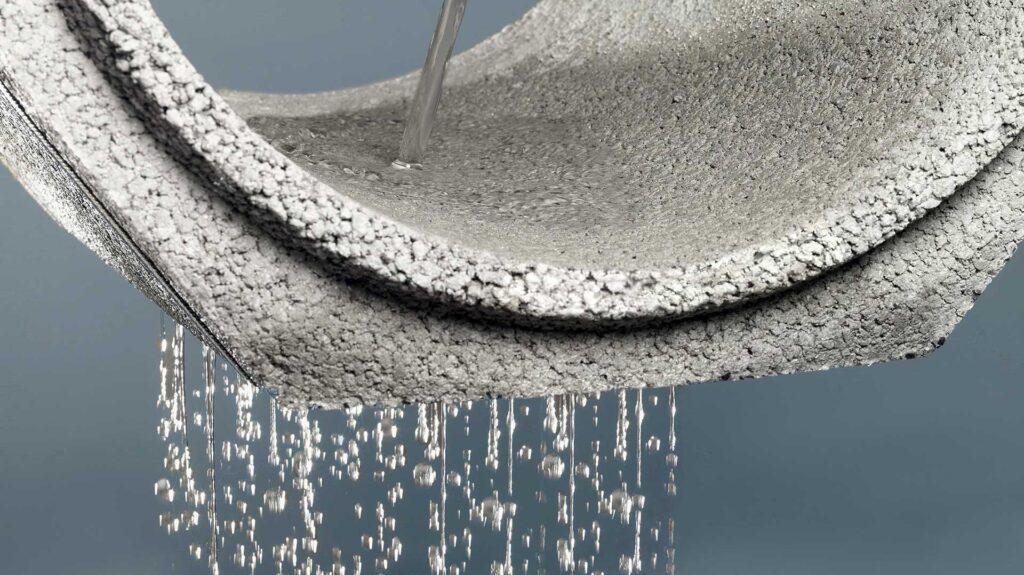
A HydroCon permeable concrete pipe is a water quality treatment device. It is an unreinforced permeable concrete pipe through which water passes, exfiltrating through the pipe walls at a rate of 0.60 litres per second per metre. The pipes are made in DN300 and DN500 standard sizes, with non-standard sizes available, and they draw on German permeable concrete pipe technology that has been installed across Australia since 2003.
The pipe is one part of a broader treatment train. Water typically passes a gross pollutant trap and an inlet pit, then enters the pipe laid at zero grade, before exfiltrating into surrounding filter, transition and drainage layers, with an impermeable liner where retention or harvesting is required. Inside the pipe, low velocity conditions allow fines to settle, which captures suspended solids along with the phosphorus and insoluble nitrogen attached to them. Alkalinity within the pipe helps precipitate heavy metals, and soluble phosphorus is adsorbed at the pipe wall. Further reductions in nitrogen, dissolved organic carbon and pathogens come from the surrounding media and biofilm.
The evidence
Research at the University of Technology Sydney has measured the water quality benefits of the system, with reported reductions of 75 per cent for total suspended solids, 45 per cent for total phosphorus and 40 per cent for total nitrogen. For engineers who need to demonstrate performance, HydroCon provides MUSIC modelling guidelines that show how to represent the pipes in a MUSIC model, size the required pipe length, and evaluate the share of flow treated as part of the wider treatment train.
Proven in the field
At Umina Beach in New South Wales, the pipes were used to prevent flooding and surface ponding, to redirect stormwater underground for infiltration, and to reduce the load on an existing network that could not simply be upgraded. The site carried real constraints, including limited pavement falls, difficult topography and environmental restrictions on ocean outflows. Geotechnical testing supported a conservative design infiltration rate, and the completed system provided at source sediment and gross pollutant retention, cut surface flooding through subsurface storage and infiltration, and remained accessible for long term maintenance. Earlier work at Kiama, dating back to 2004, shows the depth of experience behind the product.
Where the pipes fit
HydroCon permeable concrete pipes suit infiltration and drainage, coastal and ecosystem protection, bioretention systems and stormwater harvesting. They are straightforward to maintain with high pressure hosing and suction equipment, and an upstream gross pollutant trap reduces how often that is needed, extending the life of the filtration media by avoiding crusting and clogging. Throughout, the pipes function as hydraulic treatment components. Structural questions such as embedment and cover remain with the project civil engineer.
Talk to us about your next WSUD project
HydroCon has specialised in Water Sensitive Urban Design for more than 20 years. Permeable concrete pipes are a practical way to deliver water sensitive drainage on real sites, treating and infiltrating stormwater at source rather than simply moving it on. Alongside the pipes, our range includes HydroSTON permeable pavers and the Smart Soaker passive irrigation system, each designed to manage water at source. If you are planning stormwater treatment for a catchment, streetscape, reserve or development and would like to discuss how the pipes could work, we would be glad to help.
Contact us at info@hydrocon.com.au or on 1300 413 993, or visit hydrocon.com.au.